BIOGRAPHY
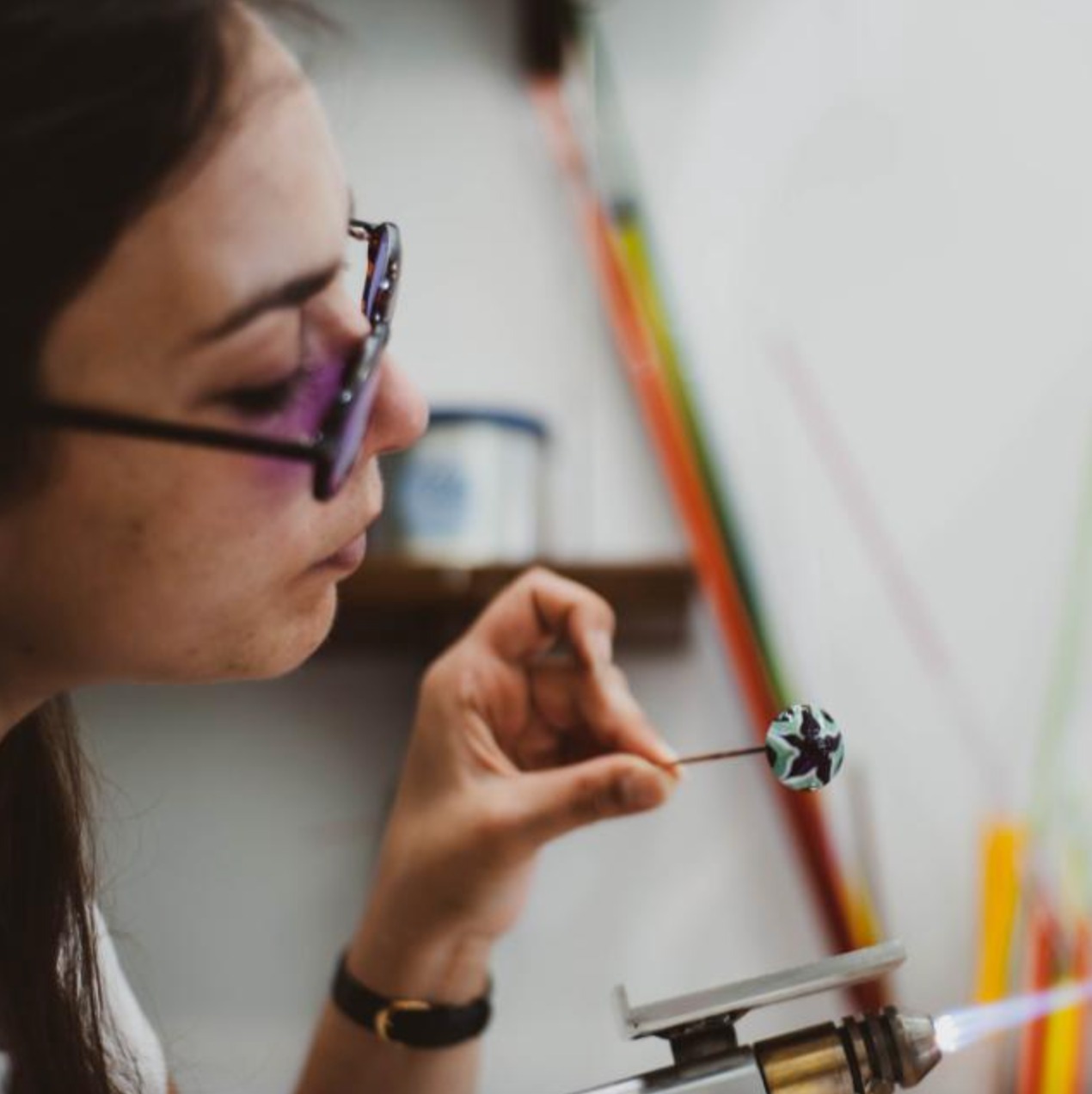
Born in Venice in 1989, Luna Darin grew up in Venice between her mother’s artisan workshop and her father’s glass-bead factory. In 2010 she began producing her own beads in her father’s workshop, gradually mastering techniques and refining her practice through training in several Murano glass laboratories.
Since 2015 Darin has served on the board of the Committee for the Safeguarding of the Art of Venetian Glass Beads, contributing to the international recognition of this craft, which was inscribed on the UNESCO list of Intangible Cultural Heritage in 2020.
In 2020 she and her partner Luca took over her parents’ historic workshop. In 2025 they opened Alchimia Vitrum, a new laboratory dedicated to the living traditions of Venetian beadmaking. The space brings together three closely related practices: the perlera (beadmaker), the impiraressa (bead stringer), and the lumista (lampworker).
Alongside the preservation of traditional techniques, Darin collaborates with contemporary artists and cultural institutions, activating these fragile micro-sculptures of glass within new artistic contexts. Instagram: @lunadarin_glassworkshop
“With Luna we experimented, searched and developed ideas to create the ‘cilia’ — deformed, stretched, long and thin. Each time a new idea led us to work differently. We enjoyed being surprised by the materiality of borosilicate glass as we manipulated it together, speaking and listening to one another.”
– Léa Dumayet
INTERVIEW WITH LUNA DARIN BY ANNA SHPILKO, CURATOR OF CILIA.
A.: How was your experience working with Léa?
Luna: Very good, really. We had a lot of fun working together. Collaborating with artists is not always easy, but with Léa it was very natural. She is very kind and very human, and we immediately understood each other. We worked closely together and the collaboration felt very fluid.
Often artists arrive with a project already fixed in their mind and expect it to be realised exactly as they imagine it, sometimes within a very short time. But glass has its own limits. The material requires time and specific processes, and not everything is possible. Sometimes artists don’t fully understand that, and part of our work is to help them enter into the mentality of the material. With Léa it was different. She was interested precisely in how the material behaves, even in its limits. That made the collaboration very natural.
A.: More generally, what is your experience when artists enter the world of glassmaking?
Luna: There is always a difference between artistic experimentation and the daily practice of craft. In our work we aim for precision and quality, and that comes from years of experience and repetition. Artists, instead, often arrive with curiosity and a desire to experiment. They want to test things, push the material, see what happens. Sometimes they do not yet have the long experience of working with glass, so there is a dialogue between these two approaches.
A.: You grew up in this world. Can you tell me about your childhood around glass?
Luna: Yes, I grew up inside it. My mother had a shop where she sold glass beads and jewellery, and after some years my father opened a factory that produced beads wholesale for clients around the world. My parents married very young, and in the 1980s they opened the shop and later the factory. My brother and I grew up in that environment. The shop was always full of people from all over the world. Even when I was a child I remember trying to speak with visitors from Australia, India or other distant places. Later I began spending more time in my father’s factory, and that is where I really fell in love with the craft.
A.:What fascinated you there?
Luna: The beadmakers. They were incredible to watch. They worked with long glass rods in the flame and it looked almost like they were dancing with fire. The rods seemed very light in their hands. It was a very demanding environment. The factory produced beads wholesale, so the work required making hundreds of identical beads every day. Sometimes five hundred or even a thousand beads in a day, all perfectly uniform. I could spend hours watching them work.
A.: Did your father encourage you to learn the craft?
Luna: Yes and no. He was happy that I was interested, but he also knew how difficult the work is. The job of a beadmaker is very demanding. When production is industrial you must produce many beads, all identical, and many are discarded if they are not perfect. Still, I insisted. When I was around nineteen or twenty, I began spending mornings in the factory learning and practising, and afternoons helping in my mother’s shop with customers and jewellery. For me, selling was one thing, but creating was something completely different.
A.: What was the atmosphere like in the factory?
Luna: It was quite lively. The beadmakers worked together around a table, each with her flame. There was always music or the radio playing. At lunchtime they would bring small pots of food from home and warm them near the flame plates where they worked. It was a very particular environment — hard work, but also a sense of community.
A.: You later studied with a glass artist in Murano. What changed for you there?
Luna: After some years in the factory I wanted to learn more. I saved money and went to Murano to take courses with a master who had once worked with my father. That experience really changed my perspective. In my parents’ generation the focus was very much on production and sales — making beads to sell. But this master approached glass in a different way. His workshop was more artistic and experimental. People came to the studio not only to produce objects but to explore the material. We cooked together, worked together, talked. It was a completely different atmosphere, much freer. That experience showed me another way of living the craft.
A.: How has the situation of glass artisans in Venice changed since then?
Luna: A lot has changed. In the past there was strong demand and the economy was different. But over time competition increased, tourism changed, and many workshops struggled. Today it is very difficult for artisans to maintain a workshop in areas with heavy tourist traffic. The rents are very high, and many visitors are not interested in the work itself — they just want a cheap souvenir. When my parents retired in 2020, the factory also closed. My partner Luca and I took over the shop, but after some time we realised that the location no longer suited the kind of work we wanted to do. So we moved to a larger space that is slightly away from the main tourist flow. It is easier to work there and to focus on the craft.
A.: Do artisans still support each other in Venice?
Luna: Yes. There are not many of us left, especially among beadmakers. When someone asks me for something I cannot make, I often send them to another artisan who can do it. We try to help each other. The craft world has become smaller, so collaboration between artisans is very important.
A.: What is a typical day in your workshop today?
Luna: Our ideal day would be simple: we arrive in the workshop, make a coffee, talk about the work we need to do — orders, projects — and then light the flame and start working. But today there is also a lot of other work. We spend time answering emails, dealing with bureaucracy, updating the website, managing social media. Sometimes that takes more time than the craft itself. Still, the moment we finish those tasks, we cannot wait to return to the flame. That is the part we truly love.
A.: Working with fire requires physical focus. How do you take care of your body?
Luna: I practise yoga. It helps a lot to stay balanced and connected with the body, especially because we spend many hours sitting and working very precisely with our hands.