Elisabeth de Brabant Contemporary
Andrea Bordács’ work investigates armour as a form historically adopted and redefined by women to assert presence, agency, and resilience. Across different cultural and temporal contexts, armour has functioned not only as protection, but as a marker of identity, strength, and continuity.
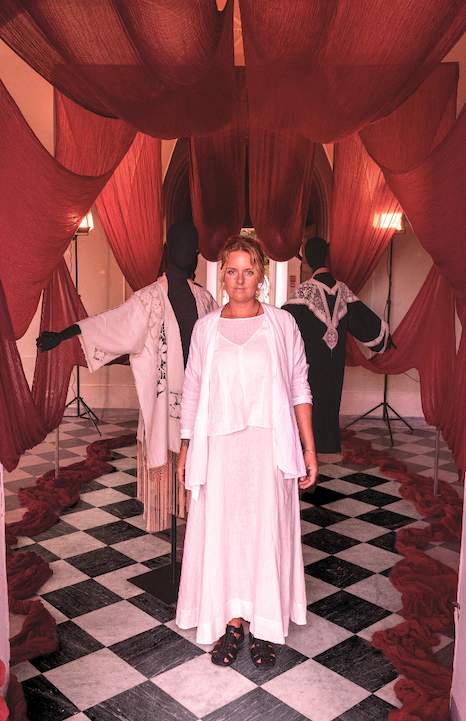
Female Armour consists of autonomous sculptural works conceived as untouchable forms. Instead of referring to combat protection, they express a restrained, non-aggressive power, grounded in endurance, destined for the preservation of life and collective structures.
While related to Bordács’ previous work for cinema and performance, these armours belong fully to her sculptural practice.
Andrea Bordács began her residency at Elisabeth de Brabant Contemporary’s Venetian space, Galleria dei Gondolieri, in December 2025. The residency will culminate with the exhibition in April, 8-13.
Within the architectural and historical context of Venice, the artist is developing a new chapter that draws from the Ocean and Forest as a connective system between territories, histories, and bodies, and as a model for circulation, exchange, and survival.
The residency follows Fuga Ascendente, presented at Villa Marigola during the Lerici Music Festival in summer 2025, which engaged with female craft traditions across Tuscany, Sicily, and Venice. The Venetian residency extends this research toward a broader field and power-charged, daring nature.
Andrea Bordács is an artist whose practice is rooted in material research and spatial thinking, shaped by a long trajectory in cinema and craft. Trained in textiles and artisanal techniques in Hungary and in set design around the world, she spent over a decade working on major international film and television productions, including Blade Runner 2049, Vikings, Marco Polo, and Borgia, where she led costume and accessory design. In recent years, she has been shifting her time more and more towards autonomous artistic work.